
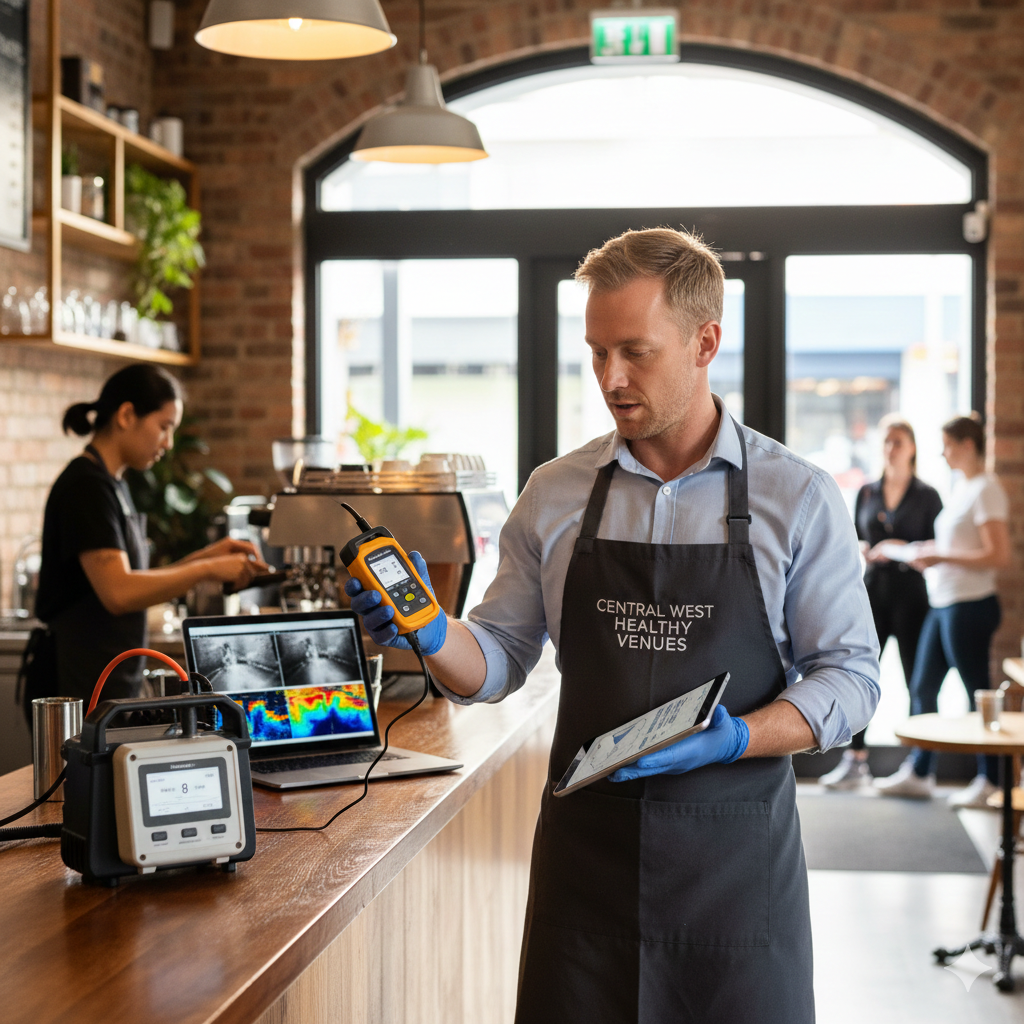
Commercial Building Biology & Air Quality Audit - Coming soon
For hospitality venues, air quality isn't just about comfort—it’s about food safety, staff retention, and the customer experience. This audit identifies environmental stressors that can lead to staff fatigue, "musty" front-of-house odours, and hidden microbial risks.
1. Advanced Air Quality & Ventilation (HVAC)
Commercial kitchens generate significant particulate matter and moisture. We assess:
PM2.5 & PM10 Levels: Ensuring your extraction systems are effectively removing combustion byproducts from gas cooking.
$CO_2$ Monitoring: High $CO_2$ in dining areas causes "post-lunch lethargy" in customers and brain fog in staff. We verify if your fresh air intake meets biological health standards.
MVOC Detection: Identifying that "old building" smell that can put customers off their food—often a sign of hidden mould.
2. Moisture Mapping & Fungal Risk
In a restaurant environment, steam and frequent wash-downs can lead to structural dampness.
Cool Room Integrity: Checking for thermal bridges and condensation points that lead to mould growth on seals and surfaces.
Behind the Line: Using moisture meters to find leaks behind stainless steel splashbacks or under commercial dishwashers before they cause structural damage.
3. Lighting & Acoustic Comfort
The "atmosphere" of your café is a physical variable we can measure.
Flicker & Spectrum Analysis: Ensuring your "warm" lighting isn't actually high-flicker LED, which can cause headaches for staff on long shifts.
Sound Mapping: Identifying resonant frequencies or mechanical hums that increase customer stress levels and hinder conversation.
4. Electromagnetic Field (EMF) Safety
Commercial kitchens are high-energy environments.
Point-of-Sale (POS) & Kitchen Tech: Measuring RF and Magnetic fields at staff workstations to ensure they are within safe biological limits for 8-hour exposures.
The Business Benefits
Reduced Sick Leave: Improved air quality leads to fewer respiratory issues and fatigue-related errors among your team.
Enhanced Patron Experience: A venue that "feels" better—through superior air and acoustics—sees longer dwell times and higher spend.
Due Diligence: A professional Building Biology report demonstrates a proactive commitment to the health and safety of your staff and community.
Odour Elimination: We find the source of smells, rather than just masking them with synthetic fragrances (which are themselves a chemical stressor).
What You Receive
Site Forensic Report: A comprehensive breakdown of your venue’s environmental performance.
Commercial Mitigation Strategy: Practical, staged recommendations that work around your trading hours.
Health & Safety Documentation: Evidence of environmental due diligence for your records.
Service Area Note: This service is strictly limited to properties within the Central West region of NSW. Please ensure your property is in this area before booking. Fees for out-of-area bookings are non-refundable.
For hospitality venues, air quality isn't just about comfort—it’s about food safety, staff retention, and the customer experience. This audit identifies environmental stressors that can lead to staff fatigue, "musty" front-of-house odours, and hidden microbial risks.
1. Advanced Air Quality & Ventilation (HVAC)
Commercial kitchens generate significant particulate matter and moisture. We assess:
PM2.5 & PM10 Levels: Ensuring your extraction systems are effectively removing combustion byproducts from gas cooking.
$CO_2$ Monitoring: High $CO_2$ in dining areas causes "post-lunch lethargy" in customers and brain fog in staff. We verify if your fresh air intake meets biological health standards.
MVOC Detection: Identifying that "old building" smell that can put customers off their food—often a sign of hidden mould.
2. Moisture Mapping & Fungal Risk
In a restaurant environment, steam and frequent wash-downs can lead to structural dampness.
Cool Room Integrity: Checking for thermal bridges and condensation points that lead to mould growth on seals and surfaces.
Behind the Line: Using moisture meters to find leaks behind stainless steel splashbacks or under commercial dishwashers before they cause structural damage.
3. Lighting & Acoustic Comfort
The "atmosphere" of your café is a physical variable we can measure.
Flicker & Spectrum Analysis: Ensuring your "warm" lighting isn't actually high-flicker LED, which can cause headaches for staff on long shifts.
Sound Mapping: Identifying resonant frequencies or mechanical hums that increase customer stress levels and hinder conversation.
4. Electromagnetic Field (EMF) Safety
Commercial kitchens are high-energy environments.
Point-of-Sale (POS) & Kitchen Tech: Measuring RF and Magnetic fields at staff workstations to ensure they are within safe biological limits for 8-hour exposures.
The Business Benefits
Reduced Sick Leave: Improved air quality leads to fewer respiratory issues and fatigue-related errors among your team.
Enhanced Patron Experience: A venue that "feels" better—through superior air and acoustics—sees longer dwell times and higher spend.
Due Diligence: A professional Building Biology report demonstrates a proactive commitment to the health and safety of your staff and community.
Odour Elimination: We find the source of smells, rather than just masking them with synthetic fragrances (which are themselves a chemical stressor).
What You Receive
Site Forensic Report: A comprehensive breakdown of your venue’s environmental performance.
Commercial Mitigation Strategy: Practical, staged recommendations that work around your trading hours.
Health & Safety Documentation: Evidence of environmental due diligence for your records.
Service Area Note: This service is strictly limited to properties within the Central West region of NSW. Please ensure your property is in this area before booking. Fees for out-of-area bookings are non-refundable.